

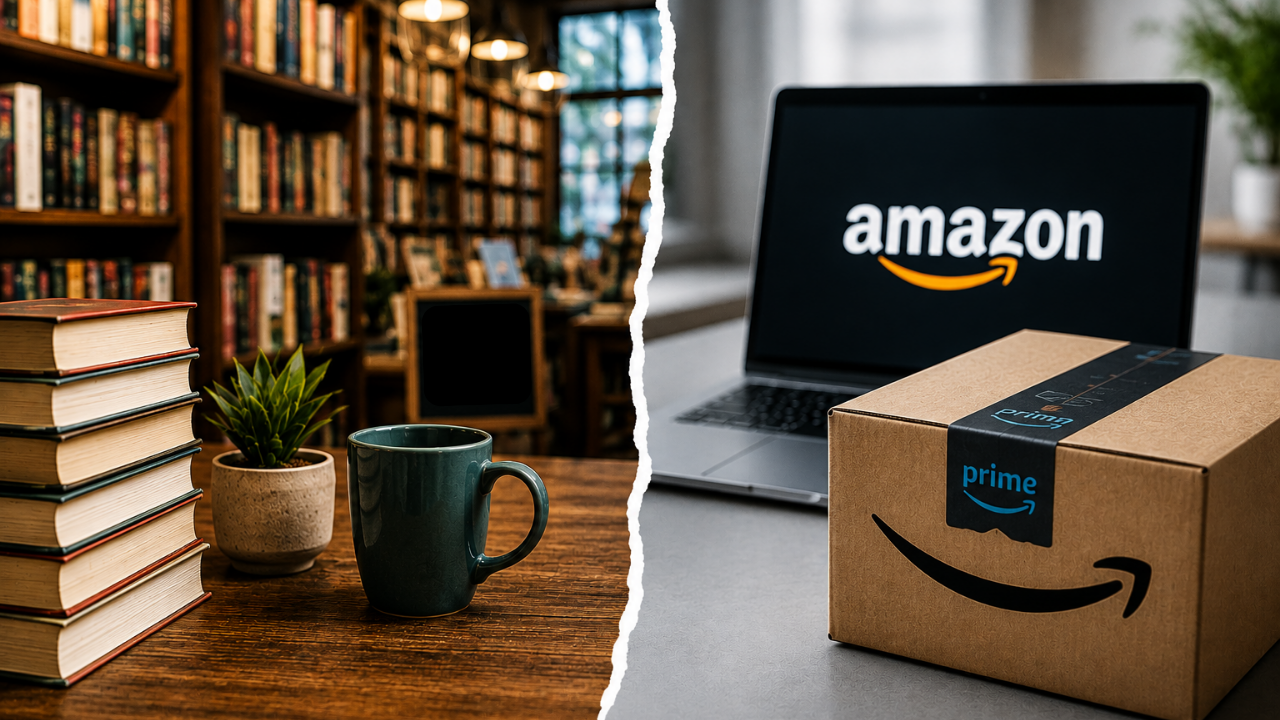
Why Is the Same Book $30 at a Bookstore and $20 on Amazon?
Have you ever walked into a bookstore, picked up a brand-new hardcover, looked at the price, and thought, $30?!
Then you pull out your phone, search the exact same title on Amazon, and there it is for $24, $21, or sometimes even less. So when you compare Amazon books vs. bookstore prices, it can feel like your local bookstore is charging way more for the exact same thing.
But that’s where book pricing gets interesting.
Your local bookstore usually didn’t decide that hardcover should cost $30. The publisher did. That $28, $30, or $32 number printed on the book is the publisher’s list price, and bookstores generally sell the book at or around that amount.
Amazon, on the other hand, may choose to discount the publisher’s price.
So when you see a $30 book at your local bookstore and the same book for $21 on Amazon, the more useful question is: How can Amazon sell books so much cheaper than bookstores?
Your bookstore didn’t come up with that $30 price
When a publisher releases a book, the publisher establishes a list price, sometimes called the retail price or cover price. That’s the $28, $30, or $32 price you see printed right there on the book.
Your local bookstore didn’t sit down one morning and decide, “You know what? Let’s make this one thirty bucks.” The publisher set that price.
The bookstore then buys copies from the publisher or a book distributor at a wholesale price and typically sells them at or around the publisher’s suggested list price.
Here’s where things get more interesting: retailers can discount that price.
And Amazon really, really likes to discount it.
Amazon is lowering the price
Let’s say a publisher sets the list price of a new hardcover at $30. Your neighborhood bookstore may sell it for $30, while Amazon lists that exact same book for $24, $21, or even less.
That price difference can make it feel like the bookstore is charging you an extra $6 or $9. What’s happening is that Amazon has chosen to sell the book below the publisher’s list price.
That distinction matters, especially when we start blaming bookstores for how expensive new releases have gotten.
Amazon has something your neighborhood bookstore doesn’t: massive scale
Amazon sells an enormous volume of products and operates a huge distribution network. Its entire business model doesn’t depend on making the economics of one hardcover work the same way a small independent bookstore needs them to.
Your local bookstore has a completely different reality.
Think about everything involved in keeping that bookstore open. There’s rent, employees, utilities, insurance, credit card fees, inventory, and thousands of books sitting on shelves waiting for someone to discover them.
There are also all the things that make bookstores fun to visit in the first place: author events, book clubs, children’s story times, curated displays, and the bookseller who hears that you loved one book and immediately hands you three more.
All of that costs money.
Your bookstore isn’t pocketing the entire $30
This is another big misconception around book prices. If you pay $30 for a book, the bookstore does not make $30 from that sale.
The store already paid to get that book onto the shelf. Whatever remains after the sale has to help cover all those expenses that come with operating a physical business.
That’s why most independent bookstores can’t shave several dollars off every major new release just to match the prices of one of the largest retailers in the world.
And it also explains something else you’ve probably noticed while wandering around a bookstore.
There’s a reason bookstores sell so much cute stuff
You came in for one book. Somehow you are now holding a tote bag, a bookmark, a candle, a mug, a puzzle, and stationery you have absolutely no need for.
There’s a business reason behind all of that temptation.
Books tend to have tight profit margins for retailers, while gifts and other merchandise can offer better margins. Selling those higher-margin items can help bookstores cover the costs of employees, rent, events, and everything else that keeps the doors open.
So yes, buy the book. But if a ridiculously specific mug about canceling plans to read somehow ends up coming home with you too, your bookstore will probably be very happy about it.
So…is buying books on Amazon bad?
I don’t think book buying has to become an all-or-nothing moral decision every time you want a new romance.
Amazon is convenient, and the price difference can matter. If you’re buying several books or trying to stick to a budget, saving $5 or $10 on each one adds up fast. And if your book budget is getting a little out of control, you can also get books for free by posting about them online like I do. Here are some tips for getting started.
There’s also value in understanding where your money goes.
When you shop at an independent bookstore, you’re helping support a place where readers can browse shelves, discover authors, attend events, and get recommendations from people who spend their days surrounded by books.
And if you love shopping online, you still have options for supporting independent bookstores without leaving your couch.
Yes, you can shop indie bookstores online
Bookshop.org allows you to order books online while supporting independent bookstores. You can choose a participating bookstore to support and shop online much like you would through another retailer.
You can also check your local bookstore’s website. Plenty of independent stores offer online ordering, so you can shop directly from them even when you don’t have time to wander the aisles.
Although wandering the aisles is kind of the whole fun part.
What are you paying for when you shop at a bookstore?
There’s still something an online retailer can’t fully recreate.
It’s walking through shelves with no idea what you’re looking for, spotting a cover you’ve never seen before, reading the first page and deciding you need it. It is asking someone who reads hundreds of books what you should try next. It’s walking out with a book you didn’t even know existed an hour earlier.
That experience is part of what you’re paying for.
So the next time you see a hardcover for $30 at your local bookstore and find it much cheaper on Amazon, remember where those numbers came from. The publisher set the list price, while Amazon chose to discount it, and Amazon’s enormous scale gives it far more flexibility to do that than your neighborhood bookstore has.
Then you get to decide what matters for that particular purchase.
Maybe you want the lowest price, the convenience of ordering online, or some of that money going toward the bookstore you hope is still hosting author events and recommending books to you five or ten years from now.
Sometimes Amazon makes sense. Sometimes Bookshop.org makes sense. And sometimes it’s worth walking into your local bookstore, paying the price printed on the cover and accidentally leaving with a candle you definitely did not need.
If you find the weird business behind books almost as interesting as the books themselves, stick around. There is a whole lot happening behind those shelves that most readers never hear about.

welcome
I'm Christina!
I'm a millennial mom, TV host, and producer from South Florida, helping book lovers discover stories worth canceling plans for and talking to people who turn bookish passion into profits on my podcast.

Popular on the blog


Meet the blogger
HEY THERE, I'm Christina
a millennial mom here to help book lovers discover stories worth canceling plans for.
Think of me as your personal book matchmaker with a side of self-care expertise. I'm here to help you find the perfect read for every mood while trying not to drop your book in the tub. (We've all been there.)
Freebie

you'll have to invent excuses for why you're late to work
Grab my free guide to 40 unputdownable books that'll make you cancel plans, stay up way too late, and possibly cry in public (#sorrynotsorry)